A Museum Visit Through One Travelling Object
A museum visit through one travelling object turns labels and material clues into a focused route through its making, movement and changing meanings.
The most common mistake on a museum visit is trying to see everything; the cost is leaving with a blur of rooms and labels, but no clear story. A museum visit through one travelling object gives your attention a smaller, more rewarding job: choose a single thing and follow the traces of where it came from, how it moved and what different people have made of it.
This is not a hunt for the most famous treasure. A modest bowl, piece of cloth or carved figure can offer more clues than a celebrated centrepiece, especially when its label records materials, makers or previous owners. The aim is to notice what the display can support, distinguish evidence from possibility and leave room for unanswered questions.
Choose a useful object
Start in a gallery whose subject gives objects room to travel: trade, migration, everyday life, religious practice or a named region. Scan labels rather than trying to take in every case. Look for an object with at least one visible material clue and one piece of recorded movement, such as a place of manufacture and a later place of use.
Choose something you can look at from more than one angle, if the case allows it. A ceramic vessel may show a repaired rim; a garment may reveal seams and contrasting fibres; a metal tool may carry wear around its handle. These details offer questions to test against the label, not answers to assume.
Keep the choice manageable. If the object’s label already refers to several regions, changes of ownership or a later use, there is likely enough to follow without touring the whole collection. If its display gives almost no context, pick a nearby object with a fuller label instead.
Read the label closely
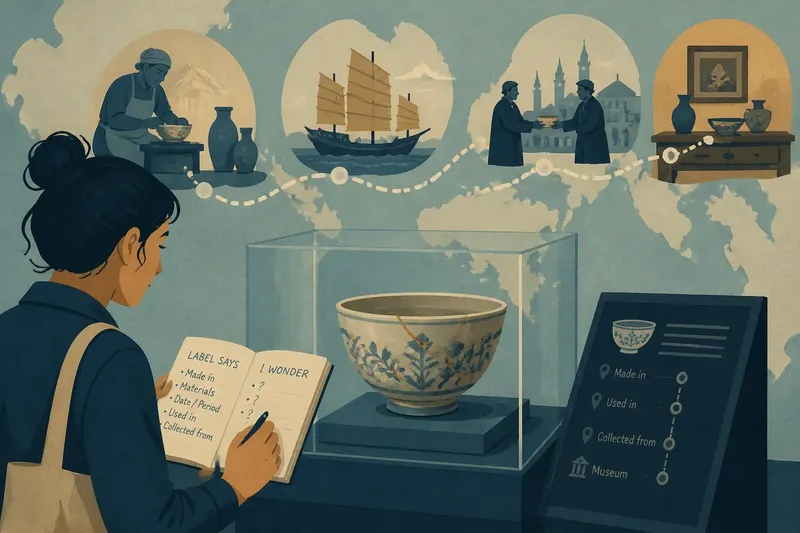
Before looking for a grand narrative, gather the basic record. Note the object’s name, the people or community associated with it, the place linked to its making, its materials and the date or period as described by the museum. Record the wording carefully: “made in”, “found at”, “used in” and “collected from” describe different relationships.
Then look for the label’s source of knowledge. Does it name a maker, refer to an archaeological context, describe a donor’s account or use cautious phrasing such as “possibly”? That wording matters. A museum may know where an object was acquired while having less information about who made it or how it reached that point.
Make a short note, or take a photograph of the label only where museum rules permit it. Separate what the museum states from what you infer: a useful page of notes might have two headings, “label says” and “I wonder”.
Trace the materials
Look closely at colour, texture, joins and signs of repair. A polished surface might suggest handling, but the display alone cannot establish who handled the object or how often. A patch, replaced fitting or worn edge can still point you towards useful questions about care, use and later alteration.
Compare these visible clues with the material list. If a textile contains wool and plant fibre, for instance, ask whether the label distinguishes them and whether it says where either came from. For a composite object, note how materials meet: a wooden handle attached to a metal head, or a glazed surface over a ceramic body, may reflect separate processes or sources.
Do not turn a material into a route without supporting evidence. Copper, silk or timber can come from many places; the object’s material is a starting point, not a map. Look for a specific source in the museum’s account, and mark any wider connection as a question for later rather than a settled fact.
Follow its movement
Now build the object’s journey from the locations the label actually names. These might include a place of manufacture, a place of use, a findspot, a port, a collector’s home or the museum itself. Put them in the order the evidence supports. If the museum does not explain the sequence, leave a gap rather than silently filling it.
Movement can mean more than a long-distance voyage. An object may have been carried between households, exchanged in a local market, taken during conflict, given as a diplomatic present or transferred through a collection. Those possibilities are not interchangeable. Look for words that identify the nature of a transfer, and note when the label gives no account.
Say you choose a small ceramic bowl whose label names a workshop in one region and says it later entered a collection in another. You can record those two points and ask what the museum knows about the interval; you should not invent a merchant, a ship or a route to join them. The useful result is a clear map with an honest blank in the middle.
Notice changing meanings
An object can keep its physical form while its role changes. A vessel made for serving food might later be displayed as a work of art, a family keepsake might become a museum specimen, or a ritual item might be interpreted through a different cultural vocabulary. Look for evidence of these shifts in the label, display title, recorded use or changes in ownership.
Ask who is doing the interpreting. Does the text name the community connected to the object, quote a maker’s account, or rely on a collector’s description? A label’s point of view is part of the object’s museum history. It does not automatically tell you how everyone understood the object at every stage.
Imagine the museum describes a carved object as a household item, while a nearby panel explains that related forms also carry ceremonial associations. Keep those statements distinct: the panel may broaden your questions, but it does not prove this particular object served both purposes. Check whether the object’s own record makes that connection.
What should you ask?
How do I choose one object?
Pick an object that interests you and has enough label information to support questions about material, place or use. A clear starting point matters more than fame or size.
What if its route is incomplete?
Record the known places and leave the missing link visible in your notes. An incomplete history is not a failed visit; it shows where the available account stops.
Can I infer a material’s origin?
Not from appearance alone. Use the museum’s wording for specific origins, and treat any further possibility as a question rather than a fact.
What if the label feels one-sided?
Note whose account it presents and what information is absent. You can look for another interpretation in the same gallery or ask staff whether the museum provides further context.
Make a compact record
Before moving on, capture the object’s story in a few lines. Include its name, the most specific making or use location given, the materials identified, the movement the record documents and one point the museum leaves uncertain. This is enough to preserve a route without turning your visit into an exhaustive research project.
Use a simple sequence in your notes: made or assembled; used or kept; transferred or collected; displayed and interpreted. Leave out any stage the evidence does not establish. If two labels disagree, record both wordings and where you saw them rather than smoothing the difference into a single account.
Where the museum offers a catalogue entry, map or audio guide, check it for details that the gallery label could not fit. Follow the museum’s rules for photography and handling, and do not touch an object or case to inspect a feature more closely.
Leave with a sharper question
End the visit by asking what would change your understanding: a named maker, a clearer account of transfer, a community perspective, or an explanation of a repair. That question gives you a sensible next step, whether it is checking the museum’s catalogue later or simply noticing how the next display frames its objects.
A museum visit through one travelling object works best when the route is precise about both movement and uncertainty. Keep the object’s material clues, documented locations and changing interpretations together, but do not force them into a seamless tale. The blank spaces are useful too: they show where a collection’s account invites another question.