The long journey of a borrowed word
Trace a borrowed word from first contact through sound, meaning and memory, and learn to read its layers without mistaking resemblance for proof.
The common mistake in tracing a borrowed word is to treat a familiar sound as a passport stamp: two languages share a similar word, so one must have taken it from the other. That shortcut can turn a plausible history into a tidy fiction. A borrowed word’s long journey is better read through several clues—its sound, meaning, earliest records and the circumstances in which speakers met.
Words travel with people, but they do not travel unchanged. A new speaker may reshape an unfamiliar sound, attach the word to a different object or carry it into a setting far from its first use. The result can preserve a faint trace of contact while telling us little about a single dramatic moment of exchange.
Begin with the word
Choose a word with a clear question attached to it. It might name a food, garment, tool, plant or social practice: subjects for which speakers often need a new term when an unfamiliar thing or custom enters daily life. A word such as “coffee” invites questions about routes of contact, but its modern form alone cannot answer them.
Write down the word’s current meanings and pronunciations in the languages you are considering. Include ordinary variants, not just the spelling in a dictionary heading. A word may sound different across regions, and its spelling may have been regularised long after people began saying it.
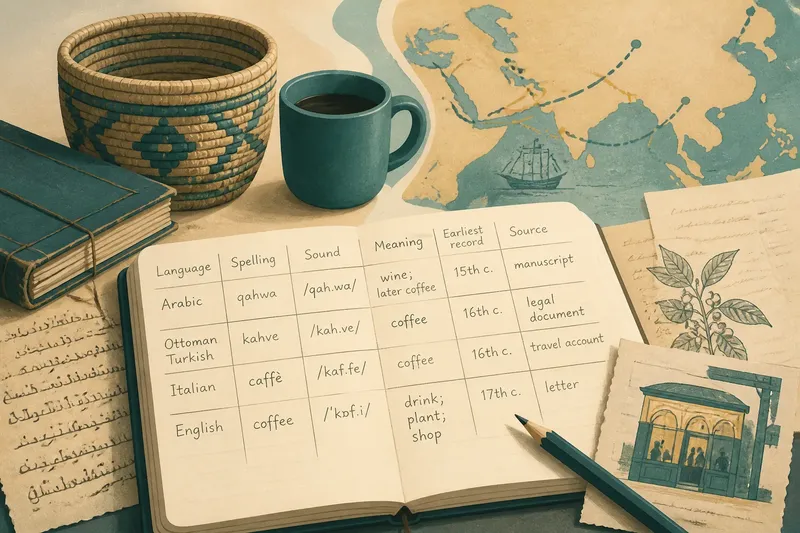
Keep a small research sheet with separate columns for language, spelling, sound, meaning, earliest dated record and source. Leave gaps where the evidence is missing. A blank cell is more honest—and more useful—than an attractive guess.
Follow the sound
When a word crosses into a new language, speakers usually fit it to sounds and patterns they already know. A consonant unfamiliar to the receiving language may be replaced with a nearby sound. A cluster of consonants may gain a vowel between them, while an ending may be trimmed or reshaped to fit local grammar.
These changes can leave a sequence of forms that resembles a route. Yet resemblance is not enough. Words can look alike by accident, and related languages may inherit similar forms from a common ancestor rather than borrow them from one another. The case grows stronger when several sound changes line up in a plausible order and the dates do not run backwards.
Spelling adds another layer. A clerk, translator or printer may write a word according to the conventions of a different language. Later readers can mistake that written shape for the sound people originally used. Where possible, compare early spellings with pronunciation notes, rhymes, transliterations or descriptions by speakers familiar with both languages.
Ask what each form would have sounded like to the people using it, not just what it looks like on the page.
Track changing meanings
A borrowed word may keep its sound while its meaning shifts. It can narrow from a broad category to one local variety, widen from a specific object to a general idea, or acquire a figurative sense. Sometimes the change happens because speakers use the word in a new setting; sometimes an older sense survives in one language after it has faded in another.
For that reason, build a meaning timeline alongside the sound timeline. Record what each early source says the word refers to, and distinguish a dictionary gloss from a real example in a sentence. A short definition can conceal important differences: a term for a drink, for instance, may refer first to a preparation, then to the plant, a shop or a social occasion.
Imagine a coastal community adopting a term for a particular woven container from visiting traders. In the receiving language, the final consonant is dropped, and the word gradually comes to mean any basket used at the market. The altered form could preserve a clue to contact, while the broader meaning reflects local use; neither change needs a single official moment.
Read records in order
The earliest surviving written record is not necessarily the moment a word arrived. It is only the earliest evidence currently at hand. A term may have circulated orally for generations before a scribe included it, especially where writing was limited to particular institutions or social settings.
Place records in chronological order, but note what kind of record each one is. A travel account, a legal document, a recipe, a dictionary and a private letter were created for different purposes. One may preserve a spoken form; another may reveal who used the word, what it referred to or whether it had become ordinary enough to need no explanation.
Pay attention to the people who wrote the records. A writer unfamiliar with a language may mishear a sound or spell it inconsistently. A translator may substitute a familiar term rather than record a new one. Such documents still matter, but their limitations belong in the account alongside their clues.
Where spellings differ, resist the urge to arrange them into a neat ladder unless the dates and sounds support that order. Several variants can coexist, and the written record may show only one corner of a much larger spoken life.
Place contact carefully
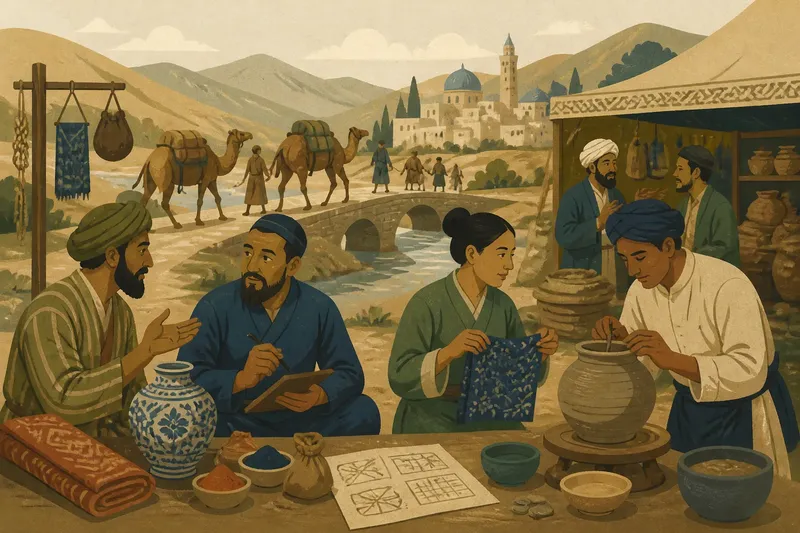
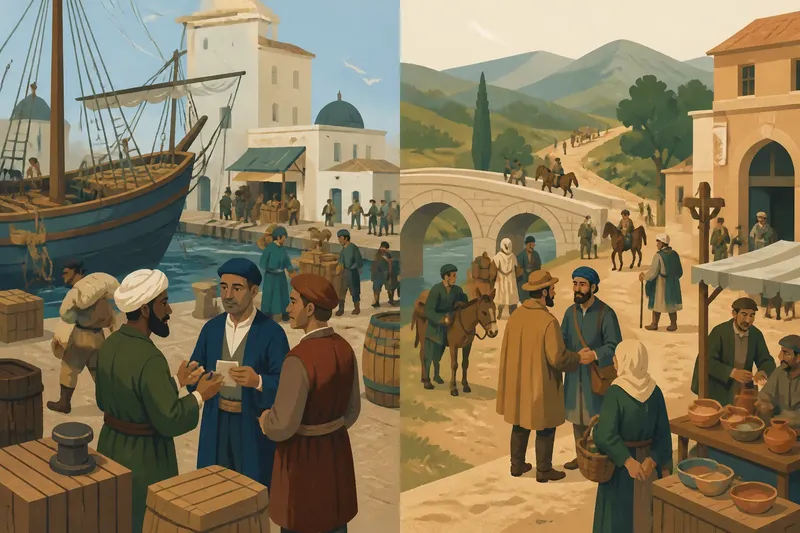
A word’s path is rarely a simple line from one named language to another. Speakers may encounter one another through multilingual households, markets, workplaces, migration, religious practice, administration or education. A term can pass through an intermediary language, or move more than once before it settles into a new form.
That complexity matters because a word’s apparent source may not be the language of the people who first brought the object or idea into a community. A term can arrive through a trading language, a neighbouring community or a written translation. The form that becomes common may reflect the last link in a chain, not the first.
Build the contact setting from evidence rather than from a map alone. Look for signs that speakers could have met: records of shared work, multilingual documents, descriptions of local use or other words borrowed in a similar period. Then separate what is known from what is plausible. “The word may have entered through a regional intermediary” is stronger scholarship than a confident route unsupported by records.
What can a word tell us?
How can you tell borrowing from shared ancestry?
Compare the word’s sounds and forms with regular patterns across related languages, rather than judging one pair in isolation. A borrowing explanation becomes more convincing when its sound changes, meaning and likely contact setting fit together; no single resemblance settles the question.
Does the earliest written form identify the source?
Not by itself: the first surviving spelling marks a record, not necessarily the first spoken use or the language of origin. Earlier oral circulation, an intermediary language or a writer’s imperfect hearing may all complicate the trail.
Why does a borrowed word change its meaning?
Speakers adapt words to the distinctions they need in a new setting, so a term can narrow, broaden or gain a figurative use. Its later sense may reveal how the receiving community made the word its own, even when the original reference remains uncertain.
Can one word prove that a particular group travelled somewhere?
A word can support a case for contact, but it rarely identifies travellers or a route on its own. Pair it with other kinds of evidence and keep the conclusion proportionate to what those sources can establish.
Keep uncertainty visible
Word histories are often presented as if each form were a station on a completed journey. In reality, the record may contain missing stretches, competing explanations and uncertain dates. Some borrowed words are easy to trace because their forms, meanings and contact settings reinforce one another. Others remain disputed, and that uncertainty is part of their history.
Use careful verbs. A form “appears in” a document; a sound “may reflect” adaptation; a proposed route “is consistent with” known contact. These phrases do not weaken an argument. They show where the evidence ends and interpretation begins.
Be especially cautious with national labels. Languages do not always match present-day borders, and people who used a word may have identified with a town, community, profession or family rather than a modern nation. Naming the relevant language variety or historical setting, when known, makes the account more precise.
Build a readable trail
A compelling account does not need to name every possible sound change. It should give readers enough evidence to follow the reasoning: the earliest useful forms, the shift in pronunciation, the development in meaning and the contact setting that makes borrowing plausible.
Use a compact table or a short sequence of dated records if it clarifies the evidence. Label uncertain dates as approximate where the source does, and distinguish a form’s written appearance from a claim about when speakers began using it. When two explanations remain possible, state what each explains and what it leaves unresolved.
The long journey of a borrowed word is not simply a story of arrival. It is also a record of how speakers fitted a newcomer into familiar sounds, useful meanings and local habits. To trace one well, follow the form carefully, test each proposed link and leave room for the parts of the journey that no surviving record can show.
Next time a familiar word seems to have crossed a border, check its oldest forms and meanings before assigning it a homeland; that small pause can keep a genuine trace of contact from becoming a tidy but unsupported tale.