What Moved Along the Old Trade Routes Besides Goods?
Old trade routes carried languages, techniques and habits as well as merchandise. See how each travelled, who carried it and why exchange went both ways.
The common mistake is to picture an old trade route as a line along which merchants carried goods from one market to another. That misses the harder-to-see traffic: words, craft knowledge and everyday habits, which could change hands without leaving a cargo list. Following those traces gives a fuller account of what routes connected—and of why exchange rarely ran in only one direction.
Routes carried more
Merchandise is the easiest evidence to recognise. A ceramic vessel, a bale of cloth or a load of spices can be counted, described and traced through surviving records. Ideas are less tidy. A way of tying a knot, preparing food or keeping accounts might travel with a person, then be adapted without anyone recording its arrival.
It helps to compare three kinds of movement: language, technique and habit. They overlap, but each follows different carriers and leaves different clues. A borrowed word may persist after the traveller has gone; a craft technique needs someone able to demonstrate it; a habit may spread through repeated encounters or through the practical demands of travel itself.
Language in use
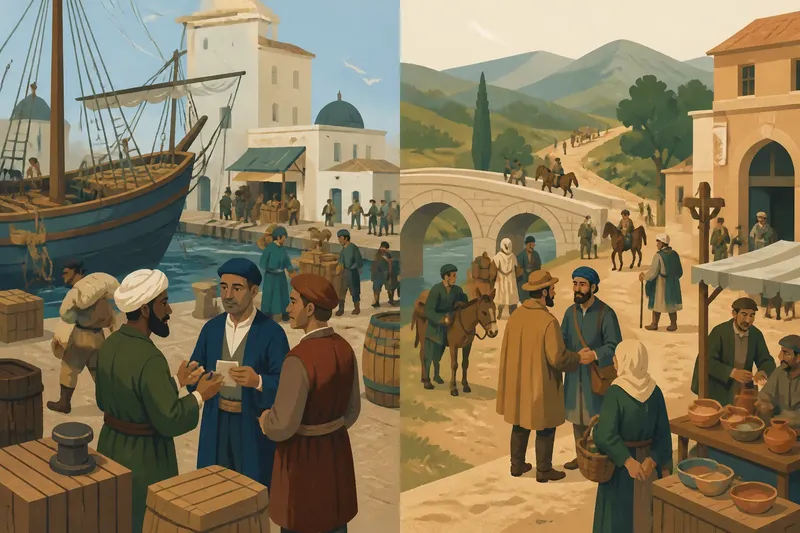
Routes put speakers in situations where communication mattered: bargaining over a price, asking directions, arranging credit or explaining a delivery. A traveller did not need to replace a community’s language for linguistic exchange to occur. A few useful terms could circulate among traders, while interpreters, hosts and local officials might know several ways to make a message understood.
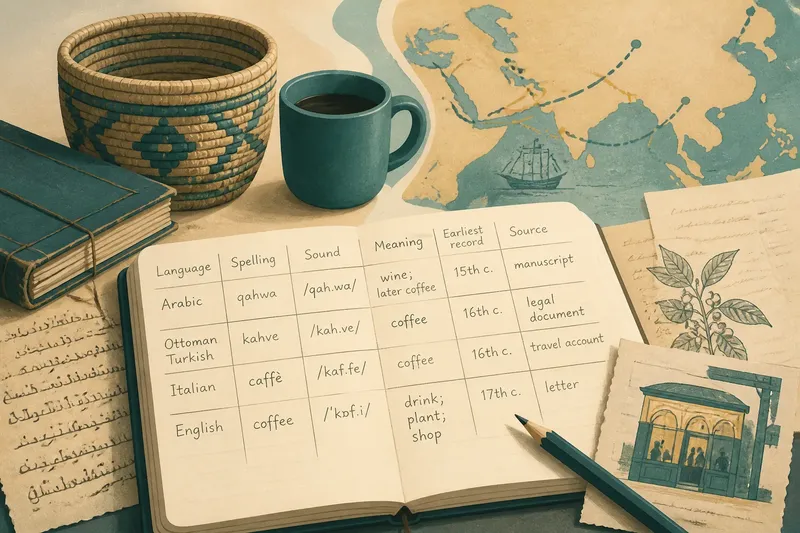
Some words travelled with a particular trade. Others belonged to the ordinary business of dealing with unfamiliar people: greetings, measures, titles or names for materials. A term could be borrowed, reshaped to fit local pronunciation and used in a narrower or wider sense than before. It might then pass onwards through speakers who had never met its first users.
Languages did not move as sealed packages. A merchant might use one language at home, another in a market and a handful of shared expressions on the road. Those choices reflect relationships and practical needs, not simply the movement of a people from one place to another.
Skills in motion
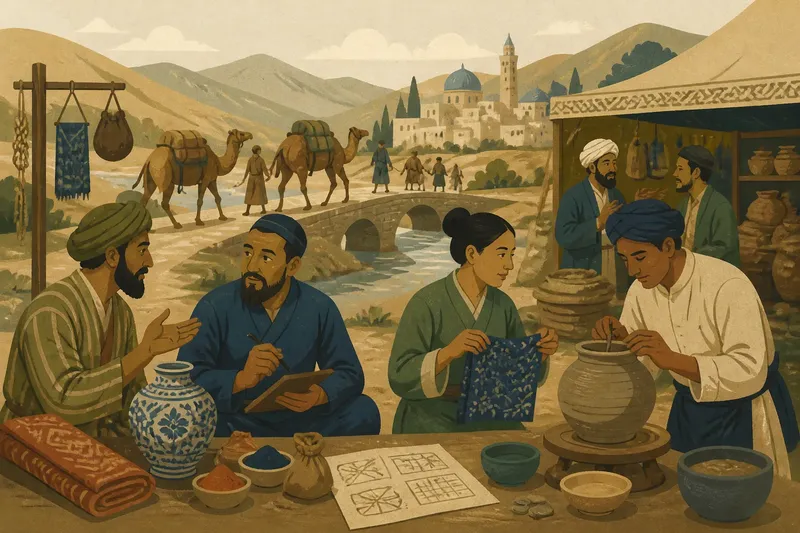
Techniques travelled most effectively when someone could show how they worked. A dyer could demonstrate how a colour took to fibre; a potter could observe the shape of a vessel and learn from its balance; a navigator could pass on ways to read winds, landmarks or the sky. The material object might prompt curiosity, but knowledge of the process was another kind of cargo.
Not every technique transferred cleanly. A method suited to one climate, tool supply or raw material might need adjustment elsewhere. Local makers could borrow one element, combine it with familiar practice and reject the rest. What emerged was not always a copy of the original. It could be a new local solution, recognisable as related but shaped by different conditions.
Skills could also travel through indirect contact. A craft worker might learn from an imported object, an instruction passed between workshops or a visitor’s demonstration. The route therefore carried both direct teaching and clues that invited people to experiment for themselves.
Habits on the road
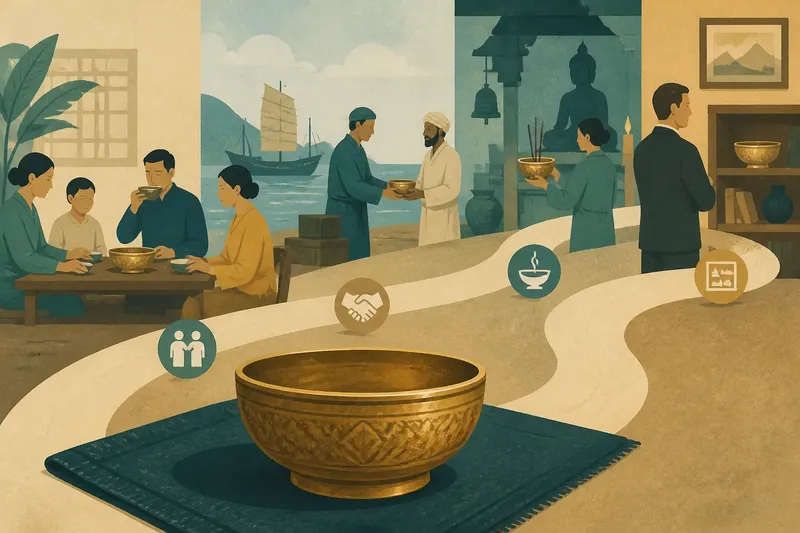
Travel encouraged routines that made movement manageable: ways of packing, eating, keeping track of provisions or greeting a host. Such habits were not necessarily adopted by everyone who encountered them. They could remain associated with a particular trade, community or setting, or become familiar through repeated use at stopping places.
Food makes the process easy to imagine without reducing it to a simple story of a dish travelling intact. A cooking method depends on available ingredients, fuel and equipment. A traveller could describe a preparation, but local cooks would decide whether it made sense with what they had. The resulting practice might share a technique while tasting and looking quite different.
Say a travelling trader arrives in a town where local cooks have a familiar grain, a clay pot and a different source of heat. The trader describes a way of seasoning and cooking a meal; a cook tries the idea with local ingredients and adjusts the timing to suit the pot. The expected observable result is a dish that carries a recognisable borrowed habit but belongs to the town’s own kitchen.
Three routes of exchange
These kinds of movement suggest three useful approaches for reading a route: follow the people who carried knowledge, follow the settings where encounters repeated, or follow the local adaptations that lasted. Each answers a different question, so the best choice depends on what evidence is available and what you want to understand.
- People and relationships: Look at merchants, interpreters, craftspeople, guides and hosts. This approach suits a question about who could teach, translate or connect communities. It is especially useful where records name occupations or relationships, though the people who left fewer written traces can remain hard to see.
- Places of repeated contact: Follow inns, workshops, markets, caravan stops and other settings where visitors and residents met more than once. This suits a question about how a practice became familiar beyond a single encounter. It can reveal the conditions for exchange without assuming every visitor left the same influence.
- Local adaptation: Compare a technique or habit with the materials and routines of the place that adopted it. This suits a question about what changed after an idea arrived. It keeps attention on local choice, but the first point of contact may be impossible to identify.
Choose the people-centred approach when a route’s carriers are visible; choose repeated places when the evidence is spread across many encounters; choose adaptation when the clearest clues are local forms and practices. A careful account can combine them, while keeping distinct the evidence for arrival, use and transformation.
Why exchange went both ways
The phrase “influence travelled” can make a route sound like a one-way channel. In practice, a visitor depended on local guides, supplies, knowledge of terrain and permission to trade. Residents, in turn, could decide what to adopt, what to alter and what to refuse. Both sides acted, even when their power or access was unequal.
Movement could also reverse direction. A traveller learned a local word or technique and carried it onwards; a host community adopted a visitor’s practice and made it its own. The same person might teach in one place and learn in the next. Exchange was not automatically equal, but neither was it simply a package sent from a centre to a passive edge.
That distinction matters when interpreting evidence. A familiar-looking object or shared term does not, by itself, show who introduced it or how others responded. Look for signs of local use and modification, and describe what the evidence supports rather than assigning a single origin to a complicated process.
Reading the traces
Different traces answer different questions. A travel account may describe a conversation but reflect the writer’s viewpoint. A loanword can hint at contact while leaving the path it took uncertain. Tools, recipes, workshop practices and repeated forms may point to adaptation, though resemblance alone cannot establish a direct link.
Start by asking what actually moved: a person, a phrase, an instruction, a material object or a routine. Then ask who used it, in what setting and whether its form changed. This keeps “trade routes spread culture” from becoming a vague claim that treats every similarity as proof of contact.
Questions readers ask?
Did trade routes spread languages?
They created occasions for multilingual communication, borrowing and translation, especially where people repeatedly negotiated or travelled together. A route could encourage shared terms without replacing the languages spoken in the communities it connected.
How did craftspeople learn distant techniques?
They could learn through direct demonstration, instruction, shared work or close study of an imported object. The technique might then be altered to suit local materials, tools and working conditions.
Did ideas travel in only one direction?
No: travellers learned from residents as well as bringing knowledge with them, and local people chose how to respond. Exchange could be unequal, but its direction was not fixed.
What evidence shows cultural exchange?
Written accounts, borrowed words, tools and changes in local practice can each offer clues. The strongest interpretation considers the setting and possible adaptations rather than treating one resemblance as a complete explanation.
Old trade routes carried more than merchandise because travel depended on people interpreting, demonstrating and adapting what they encountered. When asking what moved along the old trade routes, look beyond what arrived: the changes made along the way often reveal the exchange most clearly.