Port City or Inland Crossroads: Where Did Encounters Take Shape?
Port city or inland crossroads? Compare how harbours and overland meeting points gathered travellers, shaped contact and set different rhythms for exchange.
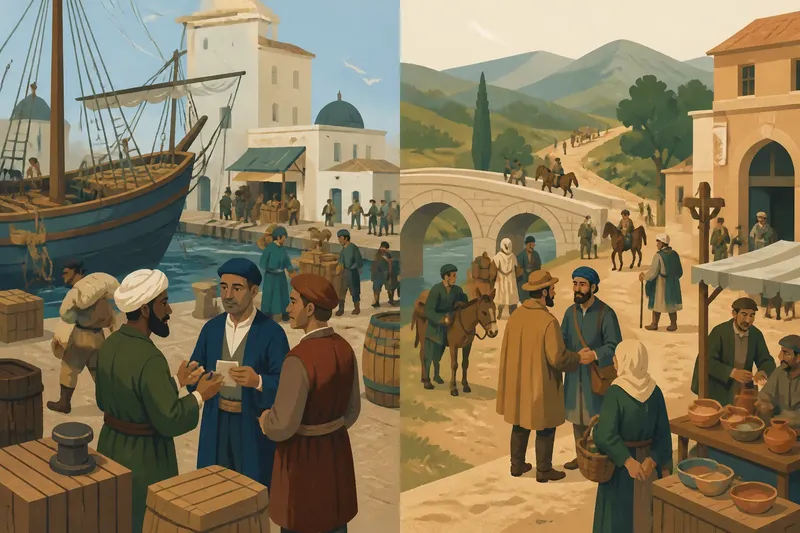
The common mistake is to treat a port city as a crossroads with seawater, or an inland crossroads as a port without ships. That shortcut hides what made each place distinctive: a harbour gathered arrivals in pulses, while a land junction could draw people into repeated, slower contact along roads, rivers and political borders. Asking “port city or inland crossroads?” means asking how geography organised the encounter, not simply where travellers stopped.
What counts as an encounter?
An encounter was more than two strangers sharing a street. It could be a negotiation between merchants, a dispute over passage, a visit to a court, a shared religious observance, or the practical work of finding food and lodging. Different kinds of contact might occur in the same place, but the setting influenced who met, how long they stayed and who controlled the terms.
A coastal harbour connected a city to maritime routes and their changing schedules. An inland junction connected overland traffic: roads crossing, a river ford, a bridge, a mountain pass, or the approaches to a market town. Some places combined these features. A river port, for instance, could gather vessels from the coast and carts arriving from the interior.
It helps to picture an encounter as a meeting shaped by movement. The port’s question was often, “Who has just arrived, and what can happen before they leave?” The crossroads’ question was more likely, “Who must pass through here, and what relationships can grow as they do?” Those are tendencies, not rules; political power, climate and local custom could alter either pattern.
Who met at a port?
Ports brought together people whose journeys depended on water: sailors, shipowners, merchants, brokers, interpreters, officials, craftspeople and visitors. Crews might arrive from different shores with distinct languages and customs. Local residents, in turn, worked in warehouses, markets, inns, workshops and customs offices, making the waterfront a place where strangers had practical reasons to speak.
Contact often concentrated around particular facilities. A quay, anchorage, customs house or market could channel arrivals into a small area. Goods needed handling; documents needed inspection; vessels needed supplies or repairs. These tasks created occasions for bargaining and conversation, but also for supervision and conflict. Authorities might regulate where foreign visitors could lodge or trade, while brokers and interpreters helped them work within local conventions.
Sea traffic could produce abrupt changes in the city’s social rhythm. When vessels arrived, a cluster of visitors might need labour, provisions, transport and accommodation. Between arrivals, those same services could be quieter. This pulse did not make port life inherently fleeting: some sailors settled, some traders returned, and neighbourhoods could sustain long-lived ties across the water. But the arrival of a ship made distant connections suddenly visible.
Port encounters were therefore often dense and task-focused. A short meeting could still matter: a contract, a piece of local information or an introduction might shape later dealings elsewhere. The harbour gathered diverse people, though their access to one another was uneven. A wealthy merchant and a sailor might occupy the same waterfront while having very different power, privacy and prospects.
How did inland junctions differ?
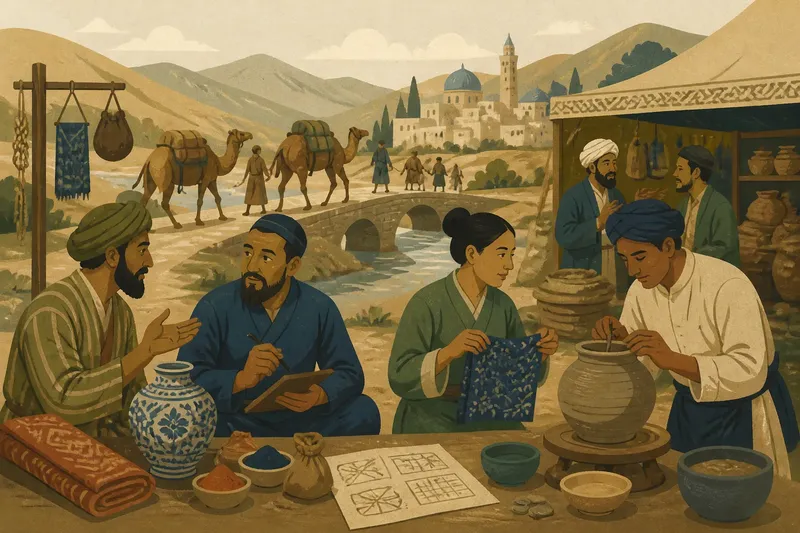
Inland crossroads drew travellers who moved by road, river, pass or bridge. Carters, herders, pilgrims, officials, messengers, soldiers and market-goers might converge there, alongside residents who supplied transport, food, shelter and services. Unlike a harbour dominated by vessels and waterfront facilities, a land junction often depended on routes that continued through the surrounding region.
Its encounters could be spread across a wider landscape. A market square might host regular exchange; an inn might bring travellers together at the end of a journey; a bridge or ford might funnel movement through a controlled crossing. A court, shrine or administrative centre could attract visitors for reasons unrelated to trade. The same route might carry a messenger in haste, a family moving between settlements and a procession travelling with ceremony.
Because many travellers reached inland meeting points in stages, contact could unfold through repeated visits and overlapping stays. Residents might recognise the seasonal arrival of particular groups, while itinerant visitors learned which officials, hosts or guides could help them onward. Such familiarity did not erase differences or prevent disputes. It could, however, turn a passing route into a web of local relationships.
The pace was not necessarily slower in every respect. A military column or urgent messenger could move quickly, and a busy market might feel as crowded as a quay. The broader distinction is that inland traffic often threaded through settlements and countryside, with encounters occurring at several stops rather than clustering only at the edge of the water.
Why did the pace of exchange vary?
Ports could make arrivals conspicuous: a vessel entered, unloaded, took on supplies and departed. Weather, tides, navigation and access to safe anchorage affected when that sequence could happen. A harbour might therefore experience busy periods followed by pauses, even as local work continued between them.
Inland routes had their own rhythms. River levels, road conditions, mountain weather, the availability of animals and the needs of travellers all affected movement. A junction might see regular traffic because several routes met there, or a surge when a market, pilgrimage or official gathering brought people together. The calendar and the terrain mattered as much as the distance travelled.
Political arrangements could speed, redirect or interrupt both kinds of movement. A toll, checkpoint, customs rule or conflict might turn an accessible route into a bottleneck. Conversely, protection and reliable services could encourage travellers to return. The visible geography sets possibilities; institutions and local decisions shape what people can actually do there.
Imagine a coastal town where several ships arrive close together. A local interpreter who knows the customs office and the market could introduce visiting merchants to sellers before the vessels leave, making the exchange intense but time-bound. Now imagine an inland bridge town where a travelling group returns along the same road at intervals: a host who recognises them may help them negotiate with local officials or find a guide. The contrast is not that one place creates meaningful contact and the other does not; each gives contact a different timetable and set of intermediaries.
Which travellers met there?
The answer depends on the routes that converged and the work a place performed. Ports particularly attracted maritime crews and people whose livelihoods depended on ships, cargoes, navigation or waterfront administration. Inland junctions more often brought together people travelling overland, including those moving between villages, market centres, courts and religious destinations.
Yet the categories overlap. A sailor could travel inland to settle a dispute; a trader might move cargo from a harbour to a market town; a pilgrim could arrive by ship and continue on foot. River ports complicate any simple division, joining maritime arrival to inland distribution. So do capitals and frontier towns, where administration or military presence could draw visitors from several directions.
It is more useful to ask what brought each group there than to label the city by one route. Look for a harbour, bridge, ferry, market, shrine, garrison or court, then ask who needed to use it. That approach reveals not just who could meet, but who had reason to stay, who could mediate and who controlled access.
What did local residents contribute?
Travellers did not create a meeting place by themselves. Local residents made movement workable. They offered rooms, food, storage, translation, repairs, credit, directions and introductions. Some worked for authorities; others operated independently or relied on family and neighbourhood ties. Their knowledge could help a visitor make sense of local practices, but it could also determine which opportunities remained out of reach.
This local role helps explain why two places on a similar route might develop different reputations. One may have reliable lodging and a market accustomed to visitors; another may be a difficult crossing with little capacity to host a crowd. A harbour’s physical shelter mattered, but so did the people who maintained its services. An inland bridge mattered, but so did the hosts, guards and traders who made its approaches usable.
Intermediaries were not neutral conduits. A broker might connect a newcomer to a seller while taking a fee or favouring familiar partners. An interpreter could clarify a bargain, but could also decide which details were passed on. Encounters therefore depended on trust, reputation and power as well as proximity.
How can you tell which setting mattered?
Start with the physical features, then trace the routines they supported. A harbour is evidence of access to water, not by itself proof that every meeting centred on maritime trade. A crossroads marks a connection, but not necessarily a busy or permanent gathering place. The stronger clues come from how people used those features.
- Find the routes: note waterways, roads, passes, bridges and ferries, then ask which journeys they connected.
- Look for gathering places: consider quays, markets, inns, shrines, courts and customs offices as distinct settings for contact.
- Identify the intermediaries: ask who provided translation, lodging, transport, security or introductions.
- Notice the rhythm: distinguish regular traffic from arrivals tied to a season, market day, pilgrimage or vessel schedule.
- Ask who controlled access: consider tolls, permissions, rules and the practical ability to enter or remain.
- Allow for overlap: check whether water and land routes met, or whether travellers continued between port and interior.
These questions keep the comparison grounded in observable features rather than a neat but misleading contest between coast and interior. They also make room for variation: an inland capital could be more cosmopolitan than a small harbour, while a port might depend heavily on connections through its hinterland.
Which setting shaped encounters more?
Neither setting automatically produced richer contact. A port concentrated distant arrivals and could bring unfamiliar people into close, practical contact; an inland junction linked movement to surrounding communities and could sustain repeated dealings. Which mattered more depended on the routes, institutions and local services that made each place useful.
Port city or inland crossroads is best treated as a comparison of conditions, not a choice between openness and isolation. The port often made far-reaching connections visible at the water’s edge; the inland junction could reveal how those connections travelled on through a region. In both, attention to the people who hosted, interpreted, regulated and redirected travellers shows where encounters actually took shape.
When considering a particular place, follow a traveller beyond the point of arrival: ask who greeted them, where they went next and what brought them back. That small shift often turns a map of routes into a history of contact.